
Project at a glance
Legal privilege keeps legal advice private so it cannot be shared with courts or investigative bodies without client permission. It covers communications between a client and their lawyer, but can also cover communications with others if the communications remain confidential and for a legal purpose.
The legal assistance sector provides free legal and social services to people experiencing disadvantage. The Commission has grouped the varied approaches to delivering these services into four models:
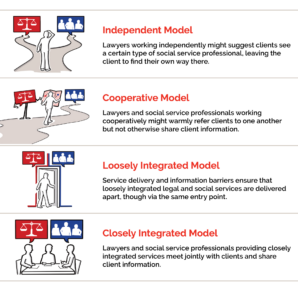
Under the Independent and Cooperative Models, legal and social services are delivered separately and there is no impact on the client’s ability to demonstrate their communications with their lawyer were confidential or for a legal purpose.
Under the Loosely and Closely Integrated Models, legal and social services are delivered by professionals working for the same organisation or partnership, making it harder for clients to demonstrate that their communications with their lawyer were confidential and legal enough to attract privilege. And the greater the level of integration, the higher the risk to privilege.
The Commission is considering two potential reform options that could enhance protection for clients accessing integrated legal assistance services. The first is establishing a privilege for social service professionals delivering loosely integrated legal assistance services. The second is establishing a new category of legal privilege that would incorporate communications with social service professionals delivering closely integrated legal assistance services.
We want to hear your views on how the law and practice on legal privilege and integrated legal assistance services currently work, and how you would like them to work.
You can make a submission by 3 August 2026.
Find out more at: lawreform.vic.gov.au/project/legal-privilege-and-integrated-legal-assistance-services/.
 |