
3. What are integrated legal assistance services?
3.1This chapter introduces integrated legal assistance services as an innovative practice development and explores its impact in the Victorian legal assistance sector.
3.2Victoria has a long history of engagement between legal assistance and social service providers. West Heidelberg Community Legal Service and Banyule Community Health have been co-located for nearly 50 years.[80] The Commission is aware of at least 84 integrated legal assistance partnerships in Victoria,[81] 59 of which are health justice partnerships.[82]
3.3Supplementing legal assistance services with social services aims to enable people experiencing disadvantage to deal with a range of interrelated issues that may feel overwhelming to address in isolation, let alone together. Social services frequently delivered alongside legal assistance services include general and specialist health services, family violence services,[83] housing and homelessness services, aged care services, youth services, and financial counselling.[84]
3.4The purpose of Australia’s governments when it comes to funding free social services alongside free legal services has been expressed differently over time, referring to the value of coordinated services in some instances, and integrated services in others. But the core objective has long been the delivery of legal and social services to enhance access to justice and life outcomes for people experiencing disadvantage.[85]
Service delivery models in the legal assistance sector
3.5Legal assistance services and social services are delivered in different ways, ranging from independent to fully integrated.[86] An increased level of integration poses an increased risk to legal privilege.
3.6The Commission has identified four models of service delivery along this continuum.
Figure 1: Models of legal assistance services
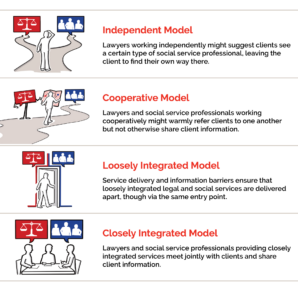
3.7Organisations or partnerships may adopt multiple models or elements of more than one model. This is particularly true of the Loosely Integrated Model and Closely Integrated Model, which are both often viewed by clients as integrated but—in the context of this inquiry—display materially different degrees of integration.
3.8Where legal assistance services are provided independently or in cooperation with social service providers, there is little risk to legal privilege because social service professionals are not present during the lawyer’s professional conversations with their client, and do not have access to the client’s privileged information.
3.9Where loosely integrated legal assistance services are provided, the client’s legal privilege should not be compromised if the protocols preventing shared service delivery and information sharing are strictly followed. As indicated in Case Study 1, the Loosely Integrated Model allows lawyers to ‘meet clients where they are at’ and work alongside social service providers while they address the clients’ complex legal needs. However, when clients are in crisis or these services are being delivered in the time and space constraints of court, rigid protocols are not always easy to follow.
|
Case Study 1: Loosely integrated legal assistance services |
|---|
|
While seeing a social worker at the Royal Children’s Hospital, a young girl disclosed she had been sexually abused by her father. The social worker referred the girl and her mother, Samantha*, to a lawyer from Inner Melbourne Community Legal (IMCL) Centre, who was located in the hospital and who met with the mother and daughter that same day. The girl had first disclosed the sexual abuse to her mother a year earlier, and Samantha had spoken to police and child protection at that time. The police determined there was not enough evidence to pursue criminal charges but obtained an intervention order allowing the father (Samantha’s husband) to continue living with their daughter, as long as he did not commit family violence. Child protection concluded that any contact between the father and daughter should be supervised and closed the file. Samantha initially remained living in the family home with her husband and children, attempting to hold the family together while keeping her daughter safe. After becoming increasingly concerned about her children’s safety, Samantha moved out of the family home with the children, but her husband continued to visit the children at their new home and school. At this point the hospital social worker became aware of the situation and referred the girl and her mother to the hospital’s legal clinic. The IMCL lawyer assisted Samantha to urgently apply for parenting orders in the Federal Circuit Court. The lawyer then appeared on Samantha’s behalf and was granted interim orders prohibiting the father from contacting the children. The lawyer also assisted Samantha to apply for a more protective intervention order. When the husband breached the order, the lawyer helped Samantha make complaints to the police and the husband was charged with a criminal offence. The lawyer also supported Samantha to lodge a divorce application, and referred her daughter to a private lawyer to pursue victims of crime compensation. The legal matters took over a year to resolve, and Samantha ultimately obtained orders for her children to live with her and have no contact with their father, in accordance with their wishes. Throughout this time, the social worker and lawyer worked separately but collaboratively with Samantha and her daughter as they navigated their way to safety.[87] * Not her real name |
3.10Where closely integrated legal assistance services are provided by legal and social service professionals in joint meetings, the client’s legal privilege would most likely be compromised, which is why service providers sometimes obtain client consent before delivering services in this way. As indicated in Case Study 2, the Closely Integrated Model aims to enable the safe and effective resolution of the clients’ legal needs, while also aiming to deliver therapeutic benefits that support client engagement and overall wellbeing. However, it is hard to know if clients fully comprehend what they are agreeing to give up (that is, control over their confidential legal information) when providing consent.
|
Case Study 2: Closely integrated legal assistance services |
|---|
|
MABELS is a partnership between the Eastern Community Legal Centre and a maternal health clinic. Women attending the clinic who are experiencing family violence are offered free legal advice, safety planning, information and referrals in the same appointment, with assistance from an Aboriginal Engagement and Liaison Worker if they are Aboriginal. Legal and social service professionals in this program do ‘not just share the space with another practitioner but feed off each other and [are] fluid in the delivery of the legal appointment’. During a maternal child health appointment, a nurse asked new mother, Maria*, how things were going at home. When Maria said she had been worried about her husband’s behaviour since the birth of their child six months earlier, the nurse offered her a place in MABELS. As Maria was worried about how she would explain the time away from home to her husband, the nurse arranged to take the baby’s measurements before she had joint meetings with the lawyer and specialist family violence worker, so it appeared as though Maria was attending a standard appointment. At her first MABELS appointment, Maria said she had never thought of her husband’s behaviour as family violence. Over the course of three appointments, the lawyer and specialist family violence worker discussed healthy and harmful relationship behaviours, and Maria disclosed the full extent of the violence she had been experiencing. The specialist family violence worker helped Maria develop a detailed safety plan, and the lawyer spoke to Maria about her legal options, including making a report to the police and applying for a family violence intervention order. Some time later, Maria got back in touch with MABELS, who assisted her to obtain a family violence intervention order.[88] * Not her real name. |
Benefits of integrated legal assistance services
3.11Integrated legal assistance services aim to provide ‘person-centred support’ focused on the needs of the client rather than the professional boundaries of distinct service providers.[89] This approach aims to benefit clients, service providers and the justice system.[90]
Benefits to clients
3.12The benefits to clients are reported to include improved access to justice, earlier intervention and better client outcomes.
Improved access to justice
3.13Integrated legal assistance services are aimed at producing three distinct benefits for access to justice.
3.14First, integrated legal assistance services can create new entry points for people who would not otherwise seek legal help.[91] By embedding legal services in hospitals, schools and community centres, social service professionals can identify the legal needs of service users and leverage their existing relationship of trust to connect those people to lawyers.[92]
3.15People experiencing disadvantage often face intersecting barriers to legal assistance, such as poverty, lack of knowledge about their legal rights, or past trauma relating to legal systems.[93] By partnering with social services that people are already engaging with (such as health care, education or aged care) integrated legal services aim to build on those trusted relationships and work holistically with people to help identify and resolve underlying legal problems which may be aggravating their health or educational difficulties. Integrating services can therefore enable legal assistance to reach a cohort of people facing complex disadvantage, who are most in need of support.
3.16In contrast to this approach, referring clients from one distinct service to another can result in ‘referral fatigue’.[94] Clients referred in this way often struggle to access the other services in a timely manner—or at all—resulting in frustration and disengagement, and the compounding of unresolved problems.
3.17Second, integrated legal assistance services can enhance access to justice by providing the social support people need to navigate legal processes that feel unfamiliar or even hostile. This support can vary from language translation, disability and mental health assistance, to support from an Aboriginal cultural safety officer.
3.18Finally, complex and interconnected socio-legal problems often require a coordinated response from multiple professionals. A mother seeking to have her children returned from Child Protection may need specialist counselling services and housing assistance, supported by a family violence intervention order and parenting order, which are made in different courts. If the client’s legal and social service professionals did not communicate with one another for fear of extinguishing legal privilege, she may struggle to decide whose advice to follow or what information she is allowed to share with each of them, and have to repeatedly recount her circumstances to separate agencies.
Earlier intervention
3.19Integrated services can identify and resolve legal problems early, reducing the level of legal assistance required and the impact on people’s lives.[95] When legal assistance services are embedded in social service delivery settings, social service professionals are better able to identify emerging legal issues and connect clients with timely support—for things such as rent arrears or unpaid fines—before they escalate into a crisis.
Better client outcomes
3.20Integrated legal assistance services aim to reduce the stress experienced by clients as result of their legal problems. Research involving patients accessing legal assistance through Inner Melbourne Community Legal Centre’s health justice partnership indicated that 48 per cent believed the legal advice they had received would positively impact their health and wellbeing.[96] International evidence on the benefits to clients similarly shows reductions in stress and anxiety, improved mental stability, better sleep, greater peace of mind, and improved wellbeing and quality of life.[97]
3.21It is reported that these outcomes are partly due to the more therapeutic and streamlined nature of the services they receive. For example, integration minimises the need for people to repeatedly recount traumatic experiences to different service providers. They also strengthen collaboration between professionals, making it harder for people to fall through the cracks.[98]
3.22In addition, legal problems are often closely intertwined with social determinants of health, such as housing insecurity, poor interpersonal relationships, and debt.[99] The World Justice Project found in 2019 that nearly a third of people surveyed had experienced physical or stress-related ill health as a result of their legal problems.[100]
3.23Resolving legal problems can therefore promote better primary health outcomes.[101] As one social worker from the Royal Melbourne Hospital remarked, ‘How can you be … taking medication daily when you’re not housed?’[102]
Benefits to service providers
3.24The benefits to service providers reportedly include enhanced service coordination, reduced vicarious trauma and more effective use of scarce legal resources.
Enhanced service coordination
3.25Integrating legal and social expertise can enhance the service quality by enabling providers to identify and manage complex client needs and risks that are difficult for any single professional to navigate, and to develop a coherent and managed response.
3.26When professionals from different disciplines work in integrated ways, they can increase their capacity to recognise interconnected issues which may be crucial to their clients’ wellbeing. First Step Legal is a community legal centre operating seven health justice partnerships. In a recent evaluation of its services, health and housing professionals reported improved ability to identify legal issues and make appropriate referrals, while legal professionals reported greater capacity to identify the impact of health and social issues on their clients and to communicate this to the court.[103] Both groups also reported ‘increased job satisfaction arising from cross-disciplinary collaboration and the acquisition of new skills’.[104]
3.27Evaluations of integrated services have found that the confidence of social service professionals has increased when it comes to identifying and supporting the client’s legal needs and has built strong relationships with the lawyers providing legal support.[105] Co-location and joint meetings helped build this trust.[106]
Reduced vicarious trauma
3.28Providing good legal advice and running a litigated matter require frank discussions with clients and often require lawyers to deliver complex or difficult news to clients who are already traumatised. Working together with social service professionals can provide therapeutic support to clients and support lawyers to maintain appropriate boundaries and work in trauma-informed ways.
|
Case Study 3: Trauma-informed integrated legal assistance services can reduce vicarious trauma for professionals |
|---|
|
A law firm partnered with a community service centre to provide pro bono legal assistance over the phone to asylum seekers. The lawyers were regularly required to deliver bad news to clients about their legal matters, and were struggling to do this in a trauma-informed way for clients with existing mental health risk factors. While the lawyers could refer clients to social service professionals within the community service centre, this support could only be provided separately to the meeting with the lawyer. The lawyers were concerned about their ability to meet their duty of care to clients and maintain their clients’ trust, and as a result were experiencing high rates of burn out and vicarious trauma. The community service centre trialled an integrated approach which enabled the pro bono lawyers to consult with social service professionals about how best to approach these difficult conversations with each client, and include social service professionals in their calls with their clients to offer direct support in the context of an existing therapeutic relationship. This meant the lawyers were able to maintain healthier professional boundaries, which reduced their levels of burn out and vicarious trauma.[107] |
Effective use of scarce legal resources
3.29An international study has found that health justice partnerships engage people who are otherwise unlikely to seek help,[108] indicating that integrated legal assistance services can overcome significant access barriers faced by clients experiencing disadvantage.
3.30Integrated legal assistance services can also reduce duplication—such as through shared intake processes—and make it easier for clients to remain engaged with services over time. These efficiencies can help service providers address the substantial unmet demand for legal assistance.[109]
3.31A UK study found that where integrated legal assistance services address the client’s underlying social issues, this may also produce social service system benefits, including shorter hospital admissions, reductions in prescription costs and a reduction in GP attendances.[110] By stabilising the client’s underlying circumstances in this way, integrated legal assistance services can also reduce the likelihood that people will re-enter the legal system with recurring or crisis-driven legal problems.
Benefits to the justice system
3.32The benefits to the justice system may include reduced demand on courts and identification and reform of systemic problems.
Reduced demand on courts
3.33By enabling early intervention and resolving issues at an earlier stage, integrated legal assistance services can prevent situations from deteriorating to the point where court proceedings are unavoidable, or where they reach crisis point and require protracted engagement with one or more courts.
3.34In addition, by addressing the underlying causes of a client’s legal problems, integrated legal assistance services may reduce the likelihood that clients return repeatedly to court over time. For example, where lawyers work closely with an alcohol and drug counselling service, a client may gain access to recovery programs that support them to stay sober and avoid breaking the law, potentially also reducing the need for ongoing involvement of agencies such as Child Protection.
Identification and reform of systemic problems
3.35Integrated legal assistance services can create opportunities for systemic analysis, advocacy and reform. By working closely with social service providers, legal aid commissions and community legal centres are well placed to identify recurring legal problems and patterns of compounding disadvantage arising from the operation of the law in these contexts. These insights enable legal assistance and social service providers to move beyond individual casework to advocate for changes to laws, policies and practices that repeatedly contribute to poor outcomes for vulnerable groups.[111]
3.36Integrated models may also support effective systemic responses by allowing proposed reforms to be informed by, and tested against, frontline experience across disciplines. For example, Legally Minded—an integrated legal assistance service in Melbourne’s north for people experiencing poor mental health—identified ‘system change and service improvement’ as a key benefit of its model, achieved through collaboration between legal and mental health professionals on both individual matters and advocacy efforts.[112]
|
Questions 1.Integrated legal assistance services involve the delivery of legal and social services by professionals working for the same organisation or partnership. Loosely integrated legal assistance services impose strict information barriers between lawyers and social service professionals providing services to clients. Closely integrated legal assistance services promote the joint delivery of legal and social services to clients at the same time, sometimes after obtaining client consent to potentially compromise privilege. How easy or difficult is it to implement these two models of integrated legal assistance services in practice? 2.What are the benefits of integrated legal assistance services for clients, service providers and the justice system? Do you have case studies, examples or other evidence you can share? |
-
Mary Anne Noone and Kate Digney, “It’s Hard to Open up to Strangers” Improving Access to Justice: The Key Features of an Integrated Legal Services Delivery Model (Research Report, Rights and Justice Program, School of Law, La Trobe University, September 2010) 15 <https://lsbc.vic.gov.au/sites/default/files/2020-08/Improving%20Access%20to%20Justice%20Research%20Report.pdf>.
-
‘2025 Strong Foundations Grant Recipients’, Victorian Legal Services Board + Commissioner (Web Page, 28 January 2026) <https://lsbc.vic.gov.au/grants-and-funding/grants/2025-strong-foundations-grant-recipients>; ‘Health Justice Partnerships across Australia’, Health Justice Australia (Web Page) <https://healthjustice.org.au/health-justice-partnership/health-justice-partnerships-across-australia/>; ‘Housing Justice Grant Recipients’, Victorian Legal Services Board + Commissioner (Web Page, 24 July 2025) <https://lsbc.vic.gov.au/grants-and-funding/grants/housing-justice-grant-recipients>; ‘Integrated Services Fund’, Federation of Community Legal Centres (Web Page, 2026) <https://www.fclc.org.au/integrated_services_fund>.
-
‘Health Justice Partnerships across Australia’, Health Justice Australia (Web Page) <https://healthjustice.org.au/health-justice-partnership/health-justice-partnerships-across-australia/>.
-
Clare Keating, Creating Lasting Change – Evaluation and Review of Hume Riverina Community Legal Service’s Family Violence Partnership with the Centre Against Violence (Report, Effective Change Pty Ltd, February 2024); Liz Curran, ‘Going Deeper’- The Invisible Hurdles Stage III Research Evaluation Final Report (Report, Nottingham Trent University, 26 June 2022) <https://hrcls.org.au/wp-content/uploads/2022/10/APPROVED-Final-Version-Going-Deeper-IH-Stage-III-Research-Evaluation-Report-20220626.pdf>.
-
Justice Connect Homeless Law, Under One Roof – Three Years of Embedding Legal Services to Make Justice Accessible for Homeless Clients (Report, November 2018) <https://justiceconnect.org.au/wp-content/uploads/2018/11/Justice-Connect-Homeless-Law-Under-One-Roof-Three-Year-Report.pdf>.
-
Council of Australian Governments, National Partnership Agreement on Legal Assistance Services (Report, 26 July 2017) <https://www.ag.gov.au/legal-system/publications/national-partnership-agreement-legal-assistance-services>; Council of Attorneys-General, National Strategic Framework for Legal Assistance 2015-20 (Report, 2019); Commonwealth of Australia and the States and Territories, National Access to Justice Partnership Agreement 2025-30 (Report, November 2024) <https://federalfinancialrelations.gov.au/sites/federalfinancialrelations.gov.au/files/2025-09/agreement-national-access-to-justice-partnership-signed.pdf>.
-
See: Michael Fine, Kuru Pancharatnam and Cathy Thomson, Coordinated and Integrated Human Service Delivery Models (No 1/05, Social Policy Research Centre, UNSW Sydney, 2005) <http://hdl.handle.net/1959.4/34416>.
-
Inner Melbourne Community Legal, Partners in Care: The Benefits of Community Lawyers Working in a Hospital Setting (Report, 2018) <https://imcl.org.au/assets/downloads/IMCL_report_FA_web.pdf>.
-
MABELS and Eastern Community Legal Centre, ‘It Couldn’t Have Come at a Better Time’: Early Intervention Family Violence Legal Assistance (Report, September 2018) <https://www.eclc.org.au/wp-content/uploads/ItCouldntHaveComeAtABetterTime-MABELS_EasternCLC.pdf>.
-
Elizabeth Tobin-Tyler et al, ‘Health Justice Partnerships: An International Comparison of Approaches to Employing Law to Promote Prevention and Health Equity’ (2023) 51(2) Journal of Law, Medicine & Ethics 332, 334.
-
Given the diversity of practice and terminology, it has not always been possible to identify the level of integration of legal assistance services within evaluations and research studies. .
-
Sarah Beardon et al, ‘International Evidence on the Impact of Health-Justice Partnerships: A Systematic Scoping Review’ (2021) 42 Public Health Reviews 1603976, 7.
-
Ibid 637; Hazel Genn, ‘When Law Is Good for Your Health: Mitigating the Social Determinants of Health through Access to Justice’ (2019) 72(1) Current Legal Problems 159, 185.
-
HM McDonald and Z Wei, Justice at a Disadvantage: What We Know Now about Legal Need, Capability and Multiple Disadvantage (Report, Victoria Law Foundation, 2025) 28.
-
Pascoe Pleasence et al, Reshaping Legal Services: Building on the Evidence Base (Discussion Paper, Law and Justice Foundation of NSW, 2014) 67.
-
Virginia Lewis, Lauren Adamson and Faith Hawthorne, ‘Health Justice Partnerships: A Promising Model for Increasing Access to Justice in Health Services’ (2019) 43(6) Australian Health Review 636, 637.
-
Inner Melbourne Community Legal, Health Justice Partnership Legal Clinics in the Hospital – Evaluation Report on the Health Justice Partnership: The Royal Melbourne Hospital and Inner Melbourne Community Legal (Report, 2018) 5 <https://imcl.org.au/assets/downloads/RMH_Evaluation%20Report%202018.pdf>.
-
Sarah Beardon et al, ‘International Evidence on the Impact of Health-Justice Partnerships: A Systematic Scoping Review’ (2021) 42 Public Health Reviews 1603976, 5.
-
MABELS and Eastern Community Legal Centre, ‘It Couldn’t Have Come at a Better Time’: Early Intervention Family Violence Legal Assistance (Report, September 2018) 28 <https://www.eclc.org.au/wp-content/uploads/ItCouldntHaveComeAtABetterTime-MABELS_EasternCLC.pdf>.
-
Virginia Lewis, Lauren Adamson and Faith Hawthorne, ‘Health Justice Partnerships: A Promising Model for Increasing Access to Justice in Health Services’ (2019) 43(6) Australian Health Review 636, 636; Stefanie Plage et al, ‘Justice in Health? Studying the Role of Legal Support in a Culturally Responsive Mental Health Service in Australia’ (2025) 35(4–5) Qualitative Health Research 418.
-
Alejandro Ponce, Global Insights on Access to Justice: Findings from the World Justice Project General Population Poll in 101 Countries (Report, World Justice Project, 2019) 7.
-
Hazel Genn, ‘When Law Is Good for Your Health: Mitigating the Social Determinants of Health through Access to Justice’ (2019) 72(1) Current Legal Problems 159, 201.
-
Inner Melbourne Community Legal, Partners in Care: The Benefits of Community Lawyers Working in a Hospital Setting (Report, 2018) 44 <https://imcl.org.au/assets/downloads/IMCL_report_FA_web.pdf>.
-
First Step Legal, Summary of Evaluation Findings (Report, 2024) 4 <https://cdn.prod.website-files.com/64e6d2582dd4319151be6a26/67ec5ac37d4a49335a3fed5a_First-Step-Legal—Summary-Evaluation-Findings-2024.pdf>.
-
Ibid.
-
Sarah Loveday et al, ‘Health Justice Partnership: An Opportunity to Respond to Childhood Adversity’ (2025) 25(1) International Journal of Integrated Care, 10 <https://pmc.ncbi.nlm.nih.gov/articles/PMC11951959/>.
-
Ibid; First Step Legal, First Step Legal – Final Evaluation Report (Report, 2017) 9 <https://d3n8a8pro7vhmx.cloudfront.net/firststep/pages/107/attachments/original/1525920080/VLSB_Final_Evaluation_Report-2017.pdf?1525920080>.
-
Preliminary Consultation 3 (Confidential).
-
Sarah Beardon et al, ‘International Evidence on the Impact of Health-Justice Partnerships: A Systematic Scoping Review’ (2021) 42 Public Health Reviews 1603976, 7.
-
Emily Millane, Angela Jackson and Nathan Blane, Justice on the Brink: Stronger Legal Aid for a Better Legal System (Report, November 2023).
-
Sarah Beardon and Hazel Genn, The Health Justice Landscape in England & Wales: Social Welfare Legal Services in Health Settings (Report, The Legal Education Foundation and UCL Centre for Access to Justice, 2018) 23 <https://www.ucl.ac.uk/laws/sites/laws/files/lef030_mapping_report_web.pdf>.
-
When using information for systemic reform, legal assistance service providers need to ensure that they do not inadvertently waive privilege when using case studies from clients in their advocacy work: Munkara v Santos NA Barossa Pty Ltd (No 4) [2024] FCA 414.
-
Laura Hayes et al, Legally Minded: Understanding How Legal Intervention Can Improve the Lives of People with Mental Ill-Health (Final Research Report, Mind Australia, March 2021) 19 <https://www.mindaustralia.org.au/sites/default/files/2023-06/Legally_minded_final_research_report.PDF>.
 |